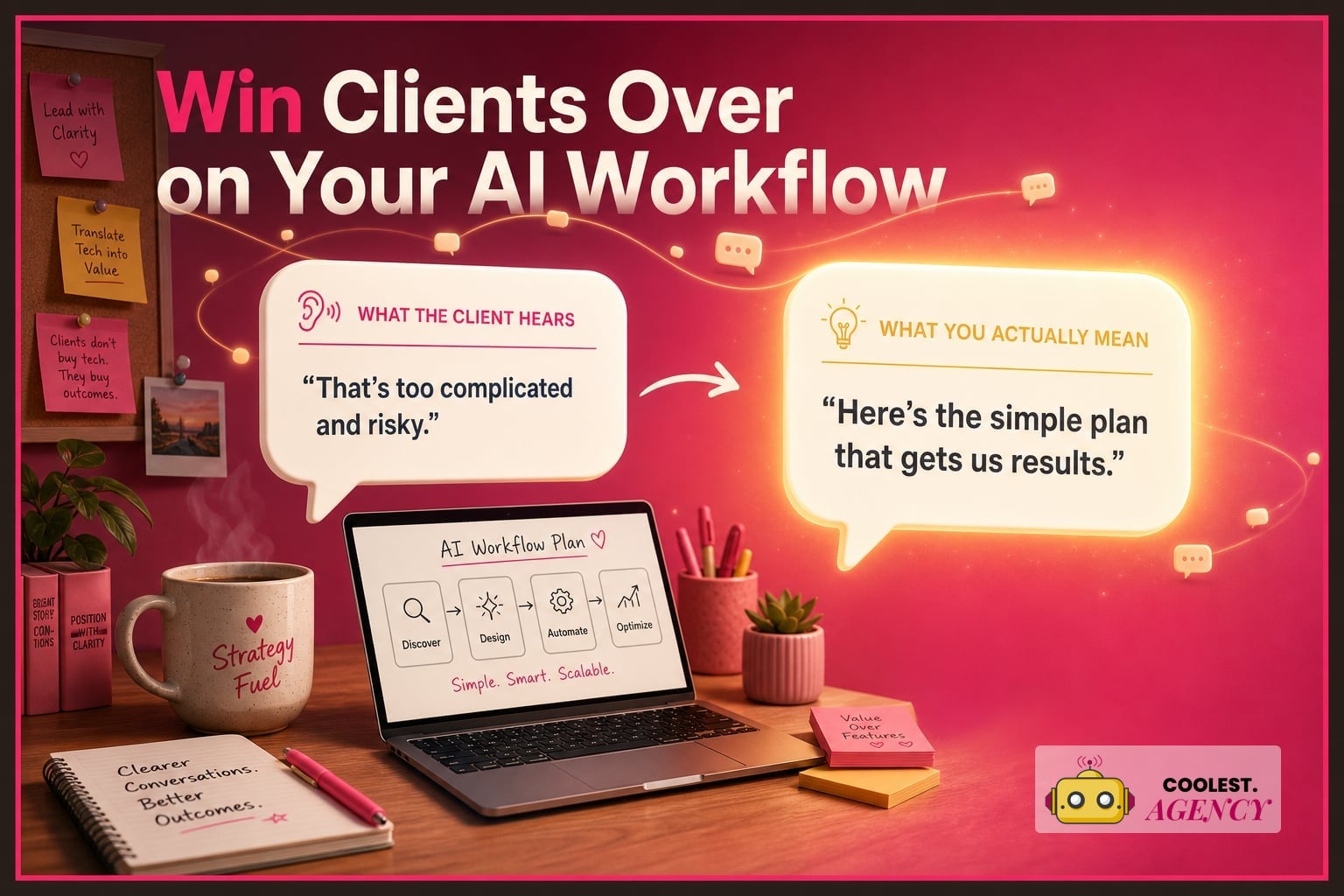
The Conversation That Wins Clients Over on Your AI-Augmented Workflow
Here's the fear nobody says out loud: clients think your AI tools mean less of you, not more. Explaining AI to clients well means naming that fear first, then showing exactly where your judgment still runs the show. Get this right and you protect your rate. Get it wrong and you're negotiating a discount you never should have offered.
Key Takeaways
- Clients pay for judgment, not hours, so lead with where your taste shows up, not with the tools you used.
- 73% of clients are more critical of commercial messaging now, per Master of Code, so vague AI talk backfires fast.
- Name the fear before they do. It disarms the room in one sentence.
Why Clients Fear Your AI-Augmented Workflow (and What They're Really Asking)
Clients don't fear AI. They fear getting a Costco portion at a Michelin price, and that's a completely different problem than the one most freelancers stumble into trying to solve.
You show them a slick AI-assisted deck and think you're proving efficiency. They see it and think: did I just get replaced by a prompt? That's the wrong argument to be having, and it's the one most people default to.
The fix isn't defending your tools. It's naming the fear directly: "I use AI to move faster, not to think less." One sentence, and half the tension leaves the room.
This lines up with what BPO operators learn the hard way. Leading with cost cuts reads as "cheaper equals worse" to buyers who've been burned before, according to Anyreach's BPO insights report. The co-pilot model for human-AI collaboration exists precisely because full automation kills the trust you're trying to build.
The Co-Pilot Script: How to Talk About AI-Augmented Work Without Losing the Room
The co-pilot script is your Unfair Advantage in three sentences: it frames AI as the engine you steer, never the driver replacing your seat at the table. When a client asks, "So what part is actually you?" that question becomes your opening move, not an ambush.
Three sentences. Memorize them: "AI handles the first draft and the grunt work. I handle the strategy, the taste, and the final call. You're paying for the second part." That's not a disclaimer. That's a rate card.
Anyreach found operators who reframed AI as a quality upgrade, not a discount, kept client trust intact even during a full platform switch (Anyreach). Same logic applies to your pitch deck.